

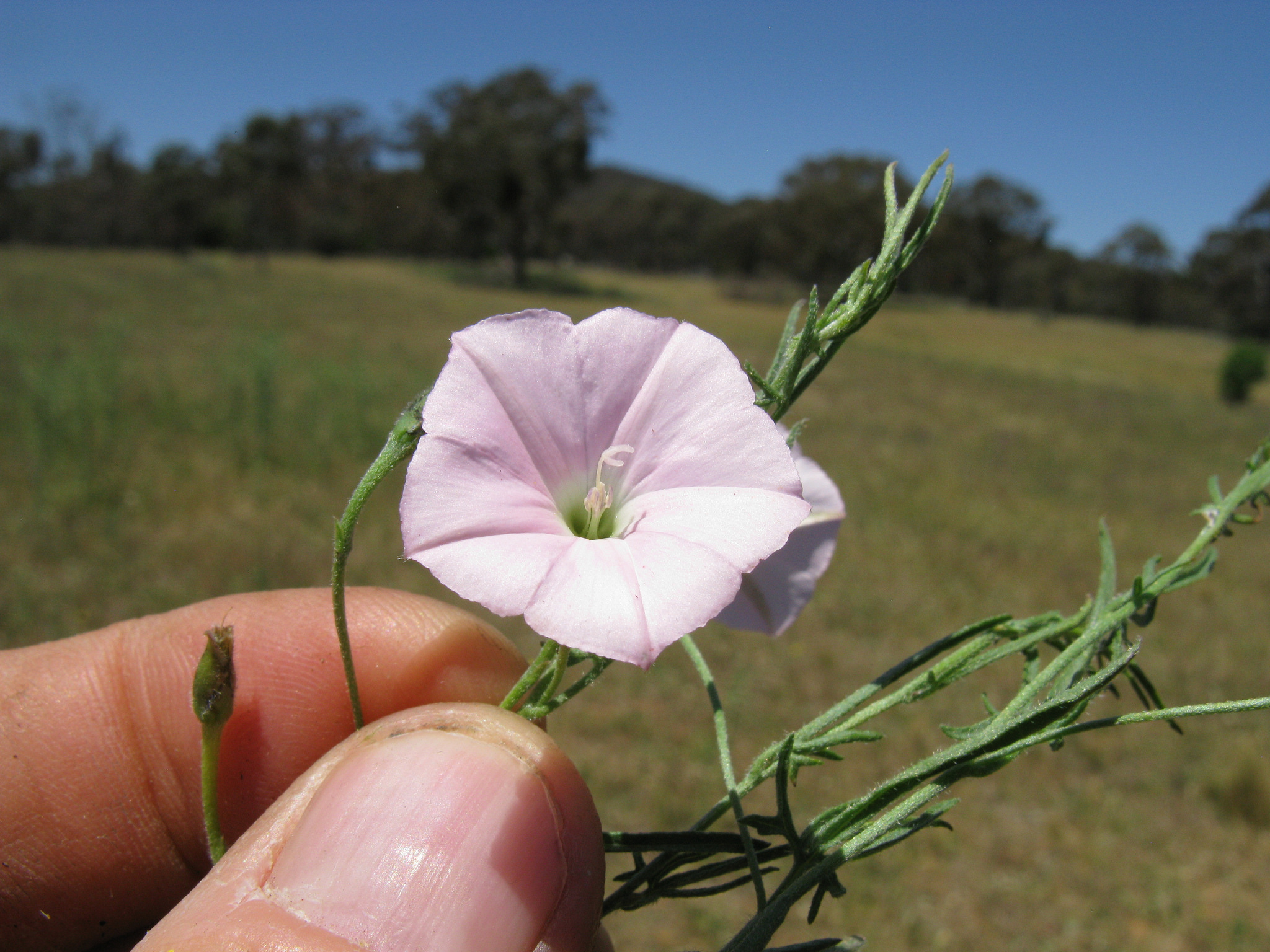
Pink Bindweed
Convolvulus angustissimus
A low creeper with thin, trailing or twining branches, spreading up to 1.5 m. Moderately to densely hairy. Leaves variable in shape with lower leaves arrow-shaped and very narrow and upper leaves oval to triangular. Single flowers pink with a paler throat, 20 mm wide and funnel-shaped.
| Details | |
|---|---|
| Flora Type | Scramblers, twiners |
| Former Scientific Name | Convolvulus angustissimus subsp. fililobus |
| Distinctive Features | The pink flowers distinguish it from the weed Convolvulus arvensis, which has white funnel-shaped flowers and many rhizomes. |
| Biology | Perennial. Grows on loamy or clay soils in grassy eucalypt woodlands or forests. Grows from a taproot. The flowers only last a day and only open in bright sunshine. Insect pollinated. |
| Native Status | Native |
| Flowering Time | Sep-Apr |
| Taxonomy | |
|---|---|
| Phylum | Tracheophyta (Vascular Plants) |
| Class | Magnoliopsida (Flowering Plants) |
| Order | Solanales |
| Family | Convolvulaceae |
| Genus | Convolvulus |
| Species | angustissimus |
The fibrous roots and leaves of some Convolvulus species were used as food by the Aboriginal people, and the leaves were used to treat indigestion and diarrhoea.
| Interesting Facts | |
|---|---|
| Similar Species | The introduced Field Bindweed C. arvensis is distinguished by its broader arrow-shaped leaves. The Convovulus genus was revised in 2001 and now many populations of C. remotus and C. erubescens are subspecies of C. angustissimus. |
| Native Status | Native |